Casa Batlló Contemporary launches Casa Batlló Dialogues with a series of talks that connects the artistic legacy of Gaudí, Miró and Gomis with contemporary creation

Casa Batlló Contemporary is launching the “Casa Batlló Dialogues” talk series with an initial cycle of three conversations linked to the exhibition “Gaudí–Miró–Gomis: Deconstructed.” Organized by Casa Batlló Contemporary and currently hosted on the 2nd floor of Casa Batlló, these sessions bring the themes explored in the exhibition into the present day. The “Gaudí–Miró–Gomis: Deconstructed” exhibition is temporarily offering a 2-for-1 promotion for residents of Spain, as well as a joint ticket with the Fundació Joan Miró.

This lecture series explores how an artist’s legacy is built and how contemporary technologies can open new ways to interpret heritage and share fresh perspectives on art, architecture, and contemporary culture.

Drawing on diverse perspectives from the worlds of art, culture, and technology, these three sessions explore the connections between Antoni Gaudí, Joan Miró, and Joaquim Gomis to address contemporary questions: how an artist’s legacy is constructed and who contributes to its consolidation; how a fresh perspective can transform our perception of a work and unlock new possibilities for interpretation; and how digital tools can reactivate cultural archives and broaden our relationship with heritage.

Three conversations, three questions about cultural legacy
“Gaudí–Miró–Gomis: Deconstructed,” presented as part of Gaudí Year 2026, brings together original works by Joan Miró, photographs by Joaquim Gomis, and newly produced audiovisual, sound, and digital installations developed by Tomorrow Bureau. The exhibition draws on the dialogue between the three creators to explore shared concepts

Casa Batlló Dialogues extends this reflection beyond the exhibition halls, situating it within the cultural context of contemporary Barcelona.

The series opens on September 16 at 7:00 PM at Casa Batlló with “Miró, Gomis and Gaudí: Connections and Deviations,” a conversation in Catalan between gallerist Jordi Mayoral (Galeria Mayoral) and cultural journalist Rita Roig. The session will explore how galleries, museums, and the media contribute to building an artist’s legacy over generations, including the role of Joan Prats in Miró’s career.

On October 14, art historian Martina Millà will analyze in “Joaquim Gomis: Another Way of Looking” how Gomis transformed architectural photography and how his perspective continues to influence contemporary visual artists. The session is organized in collaboration with the Fundació Joan Miró and will soon feature additional participants to complete the conversation.

The series will continue on November 5 with «Tomorrow Bureau: Living Archive», a conversation between Jack Featherstone, co-founder of Tomorrow Bureau, and curator Francesca Gavin, on the potential of artificial intelligence, 3D scanning, and other digital technologies to reactivate cultural archives. The conversation will also provide insight into the creative process behind «Gaudí–Miró–Gomis: Deconstructed», where these tools are used to analyze, reconstruct, and transform the works and images of the three creators. The session will be held as part of the Mira Festival in Barcelona, where Featherstone will also independently deliver the opening lecture «Deconstructing Giants in the Age of AI» on November 4.

Detailed information and tickets are available at contemporary.casabatllo.es/dialogues

Combined ticket with the Joan Miró Foundation
Coinciding with the launch of Casa Batlló Dialogues and aiming to bring “Gaudí–Miró–Gomis: Deconstructed” closer to the local public, Casa Batlló is also offering a joint ticket with the Fundació Joan Miró. Visitors can purchase a single combined ticket that provides access to both “Gaudí–Miró–Gomis: Deconstructed” at Casa Batlló and the Fundació Joan Miró, at no additional cost compared to an individual ticket. The joint ticket can be booked here.

Casa Batlló Contemporary and Fundació Joan Miró present the exhibition “Gaudí-Miró-Gomis: Deconstructed”

Gaudí-Miró-Gomis: Deconstructed opens on July 8, 2026, as the second major exhibition at Casa Batlló Contemporary, the exhibition space located on the building’s second floor, dedicated to activating Gaudí’s legacy through contemporary creation.

Casa Batlló Contemporary inaugurated its exhibition space on the second floor of Casa Batlló in January 2026 with Beyond the Façade, the first exhibition in Spain by the London-based studio United Visual Artists, which defined a new line of artistic programming linked to visual experimentation and a dialogue with Gaudí’s architecture.

In Dialogue: Gaudí, Miró, Gomis
The project, developed by the creative studio Tomorrow Bureau and curated by Joana Seguro (Casa Batlló Contemporary) and Ester Ramos (Fundació Joan Miró), proposes a new interpretation of the connections between Catalan artists Antoni Gaudí, Joan Miró, and Joaquim Gomis, bringing original works by the three creators into dialogue with unprecedented digital installations.

The exhibition brings together original works by Joan Miró (sculptures and graphic art) alongside photographs by Joaquim Gomis, whose perspective was key to the dissemination and modern reinterpretation of Gaudí’s work.

This historical collection is enhanced by a contemporary layer of audiovisual, sound, and digital pieces that reinterpret the works through tools such as animation, 3D scanning, and generative artificial intelligence, creating an immersive environment that expands their perception.

Tomorrow Bureau’s interventions function not merely as visual assets, but as research tools that allow works to be examined from new perspectives. Through these processes, forms are analyzed, reconstructed, and transformed, revealing material and structural dimensions that remain invisible to the naked eye.

Far from a historical approach, the exhibition addresses the work of the three creators as a system of living relationships. Gaudí, Miró, and Gomis shared the same territory, the same landscape, and the same Barcelona: their works did not emerge in parallel but in conversation, within a cultural ecosystem where Gaudí’s architecture was a living presence and a constant source of inspiration. The exhibition articulates this dialogue around shared themes such as nature, matter, and artistic experimentation—central elements in their respective practices.

Born from a collaboration with the Fundació Joan Miró, this exhibition revisits the show held in 2019 and projects it into the present through a new curatorial approach. Tickets will be available starting June 25.

About Tomorrow Bureau
Tomorrow Bureau is a London-based creative studio working across the fields of moving image, spatial design, and digital methodologies. Founded in 2019, the studio operates at the intersection of design, research, and narrative, developing projects that engage with contemporary cultural and technological shifts while examining how these forces shape new visual and perceptual possibilities. Their practice combines creative direction with a process-led experimental approach, balancing curiosity and play with clear intent.

Working with a diverse and constantly evolving suite of digital tools, Tomorrow Bureau creates high-resolution visual works that reveal new narratives and relationships within their subject matter. Their approach treats image creation as a form of research, utilizing advanced digital processes to translate complex ideas into rich and unexpected visual experiences.

In addition to its ongoing research initiatives, the studio has collaborated with world-leading brands such as Chanel, Dior, Nike, Prada, and Apple. Its work is progressively expanding into spatial and exhibition contexts, engaging with cultural institutions and research projects that explore more immersive and multisensory formats.

Casa Batlló Contemporary joins MACBA’s Aurèlia Muñoz Centennial

The collaboration between Casa Batlló Contemporary, MACBA, and the Sagrada Família establishes a natural dialogue between the work of Aurèlia Muñoz and the universe of Antoni Gaudí. Both practices share a profound relationship with architecture, nature, material experimentation, and the search for new ways of inhabiting space.

Coinciding with the start of the Centenary, the MACBA atrium is hosting three reconstructions of the iconic Pájaros-cometa (Kite-birds) starting this month. These suspended sculptures, conceived by Muñoz in the early 1980s, were originally presented in large-scale spaces filled with natural light. Today, the pieces regain their monumental and poetic dimension in an installation produced by MACBA in collaboration with Casa Batlló Contemporary.

 data-eio=
View of the MACBA atrium featuring one of the Bird-kites installed for the Aurèlia Muñoz Centenary. Photo: Roberto Ruiz

The commemoration will culminate in the major retrospective Aurèlia Muñoz. Entes, co-produced by MACBA and the Museo Reina Sofía, which will be open to the public in Barcelona from November 2026 to March 2027. The exhibition will review five decades of artistic production spanning textiles, sculpture, drawing, architecture, and material research.

Aurèlia Muñoz’s work anticipated many of the issues central to contemporary creation today: sustainability, interspecies relationships, interdisciplinarity, and the dialogue between art, craft, technology, and the environment.

For Casa Batlló Contemporary, participating in this Centenary means continuing to expand the connections between Gaudí’s legacy and the contemporary voices that, across various disciplines, continue to imagine new forms of creation, experimentation, and sensitivity.

Casa Batlló’s Mapping 2026 consolidates its position as a benchmark for public art in Barcelona and launches with the first exhibition of Casa Batlló Contemporary

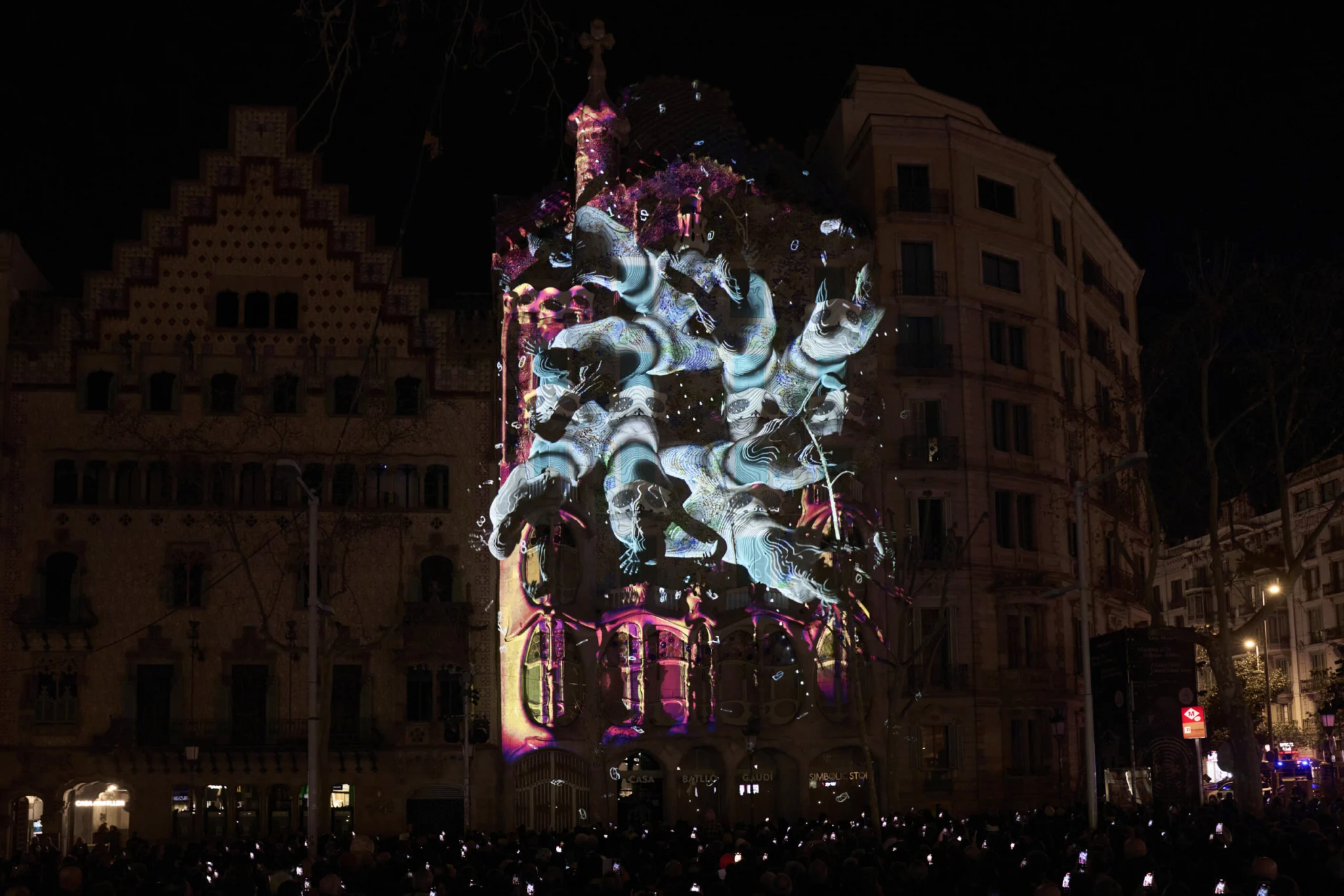
Casa Batlló successfully presented Hidden Order, a monumental audiovisual work by Matt Clark, founder of United Visual Artists (UVA), marking the inauguration of the Gaudí Year 2026. Presented as a public and free event, the fifth edition of the Mapping once again transformed the façade of Gaudí’s building into a powerful space for collective experience, attracting tens of thousands of spectators to the streets of Barcelona.

Conceived as a large-scale audiovisual performance, Hidden Order explored the cycles of emergence, chaos, and transformation, resonating with “L’ordre invisible,” the official motto of the Gaudí Year 2026. The piece combined light, movement, and sound in collaboration with choreographer Fukiko Takase and composer Daniel J. Thibaut, integrating architecture, technology, and the human body into a single performative gesture. The experience was further intensified by the live performance of Fukiko Takase, whose presence activated the façade in real time, creating a direct and emotional dialogue between the building, the urban space, and the gathered audience.

Matt Clark señala:

“It is an honor to present Hidden Order, alongside my incredible collaborators, especially as it marks the 100th anniversary of Gaudí’s passing. Similar to the feeling one experiences after visiting a Gaudí building, I hope the audience is left with a sense of wonder and reverie.”

The Casa Batlló Mapping is established as a defining moment in the cultural and civic landscape of Barcelona, solidifying the projection mapping commissions of Casa Batlló Contemporary, the institution’s artistic program, as one of the most important urban art initiatives in Europe and a must-see event on the city’s cultural calendar.

Matt Clark, from United Visual Artists, adds:

“If there’s anything to take away, it might be a greater awareness of how order and uncertainty coexist, not just in architecture or art, but also in the way we perceive the world more broadly.”

Beyond the Façade: The exhibition beyond the Mapping

For the first time, the Mapping also marked the inauguration of Beyond the Façade, the inaugural exhibition of Casa Batlló Contemporary, held in its new artistic space on the second floor, which was launched yesterday, January 31, in parallel with the mapping.

Created by United Visual Artists, the exhibition was conceived as an extension of the intervention on the façade, offering a more serene and immersive experience, structured as a journey from light to darkness. Through this progression, the exhibition deepens the dialogue between Gaudí’s legacy and contemporary creation.

Beyond the Façade will remain open until May 17, 2026.

PRACTICAL INFORMATION

Exhibition: Beyond the Façade – United Visual Artists
Dates: January 31 – May 17, 2026
Second floor of Casa Batlló
Access: included with the cultural visit or with a separate ticket

Exhibition Info and Tickets here

Casa Batlló Contemporary opens its doors with the exhibition “Beyond the Façade” by United Visual Artists

Presented in the newly restored second floor exhibition space, the show transforms Gaudí’s iconic house into an immersive environment where light, movement, sound and architecture converge. Conceived specifically for Casa Batlló Contemporary, Beyond the Façade explores the invisible systems that shape both nature and human experience, expanding Gaudí’s legacy through contemporary artistic languages.

Founded and led by artist Matt Clark, UVA is internationally recognised for creating large-scale installations that merge technology, sculpture, performance and spatial perception. For Casa Batlló, the collective developed an exhibition that unfolds as a sensory journey, where visitors move between darkness and light, rhythm and stillness, chaos and order.

At the heart of the exhibition is Seven Suns, a site-specific kinetic installation composed of rotating mirrored discs that reflect and distort the surrounding space. Alongside it, the exhibition includes deconstructed elements from UVA’s projection mapping Hidden Order, spatial sound compositions and immersive audiovisual environments that extend the experience beyond the façade and into the interior of the house.

The opening of Beyond the Façade also marks the official launch of Casa Batlló Contemporary, a long-term artistic programme dedicated to fostering dialogue between art, architecture, technology and culture. Rooted in Gaudí’s radical spirit of experimentation, the initiative commissions and presents contemporary works that challenge traditional boundaries and create new ways of engaging with heritage.

The inauguration coincided with the presentation of Hidden Order, UVA’s large-scale mapping projected onto the façade of Casa Batlló during the first weekend of February. The audiovisual performance transformed the building into a living system of light and movement, reinforcing Casa Batlló Mapping as one of the leading public digital art events in Europe.

Casa Batlló Contemporary, a new book
Expanding on this inaugural season, Casa Batlló Contemporary has launched its first eponymous publication. The book documents the program’s evolution through the works of Refik Anadol, Sofia Crespo, Quayola, and United Visual Artists, combining specially commissioned essays, artist interviews, and visual documentation of the mappings and exhibitions.

More than a catalog, this publication reflects Casa Batlló Contemporary’s vision of heritage as a living and constantly evolving platform—a space where Gaudí’s imagination continues to inspire contemporary artists across diverse disciplines and generations.

Casa Batlló presents the 2026 Mapping and the new exhibition by United Visual Artists

One of Barcelona’s most anticipated cultural events returns: a spectacular light and music show that attracts thousands of people every year. This year’s Casa Batlló Mapping a monumental artwork titled “Hidden Order”, will be projected onto the façade of Casa Batlló on 31 January and 1 February 2026, from 7.45 pm to 10.45 pm, every 30 minutes.

The event marks the first major highlight of Gaudí Year 2026 and inaugurates Casa Batlló’s new exhibition space dedicated to contemporary art, opening with an exhibition by the same artist. Both initiatives form part of Casa Batlló Contemporary, Casa Batlló’s artistic programme inviting renowned artists to reinterpret Gaudí’s radical legacy through a multidisciplinary and contemporary lens.

Discover how “Hidden Order” was created

In this video, we explain the creation process of a mapping that, for the first time, incorporates dance as a fundamental visual element.

Mapping 2026: A public artwork for the city

Conceived as a large-scale audiovisual performance, “Hidden Order” transforms the façade of Casa Batlló through a spectacle of light, movement and sound. Created by Matt Clark, founder of United Visual Artists (UVA), the work introduces a new visual and conceptual approach, unfolding through cycles of creation, emergence, chaos and transformation, exploring the tension between order and disorder at the core of Clark’s practice.

The title of the mapping connects with “Gaudí, the invisible order”, the official motto of Gaudí Year 2026, highlighting the architect’s ability to combine imagination with scientific rigour through the observation of nature. “Hidden Order” refers to the idea that beneath apparent chaos lies an underlying structure shaped by patterns, geometry and natural laws.

Matt Clark explains:

“Gaudí once said that the straight line belongs to man and the curve to God. He believed nature is governed by deep geometric principles. As an artist, I’ve always been drawn to the hidden systems beneath the surface — those structures that quietly shape the world around us.”

María Bernat, Director of Casa Batlló Contemporary, adds:

“United Visual Artists’ work perfectly embodies the spirit of Casa Batlló Contemporary: openness, risk-taking, research, and the ambition to create experiences that cannot exist anywhere else.”

A performative artwork: movement, sound and architecture

To create “Hidden Order”, Clark collaborated with international dance artist and choreographer Fukiko Takase. Clark recorded her movement using motion capture technology, integrating the dancer’s body as a central visual element on the façade. Using a state-of-the-art infrared camera system, Takase’s choreography is transformed, multiplied and reinterpreted as dynamic visual structures, embedding the corporeal figure directly within the architectural surface. Takase’s movement is shaped through direct contact with the building. Dancing inside Casa Batlló, she responded to its curves, textures and atmosphere, treating the architecture as a partner rather than a backdrop.

Developed in close dialogue with Matt Clark and Fukiko Takase’s movement, composer Daniel J. Thibaut created an original score for “Hidden Order”. Drawing on geometry and natural patterns, the composition guides the work through different phases, from minimal pulses to expansive sequences. The score allows the façade to “find its own voice,” uniting sound, movement and light into a single performative experience.

“Beyond the Façade”: The exhibition beyond the mapping

Opening alongside the mapping on 31 January 2026, Casa Batlló presents “Beyond the Façade”, the inaugural exhibition of its new contemporary art space. Conceived as an extension of “Hidden Order”, the site-specific exhibition proposes a journey from natural light into darkness, tracing cycles of day and night, order and disorder.

Through light studies, motion-based projections and kinetic sculptures, Matt Clark draws on natural geometry, choreography and philosophical reflections on time and systems.

A key reference in this research is Ramon Llull, the 13th-century Majorcan philosopher and mystic, often considered a precursor to algorithmic thinking. His system Ars, based on diagrams and rotating wheels, sought to reveal the hidden order of the world through logic and geometry. Both Llull and Gaudí shared a belief in nature as a structured, intelligible system.

Matt Clark describes it as:

“A slower, more reflective counterpoint to the façade mapping… an opportunity to look more closely at the ideas and processes behind the work.”

María Bernat adds:

“The exhibition seeks to transform visitors from spectators into participants, creating an immersive experience through the use of technology, light and the architectural space of Casa Batlló.”

Gaudí Anniversary: A living legacy

To speak of Antoni Gaudí is to speak of a singular way of understanding the city, art and nature. A century after his death in 1926, his work remains profoundly influential. His radically innovative architecture reshaped Barcelona and established the city as a global reference for Modernisme.

The year 2026 marks an exceptional moment: officially declared Gaudí Year 2026 by both the Government of Catalonia and the Government of Spain as an Event of Exceptional Public Interest, and coinciding with Barcelona’s designation as World Capital of Architecture. In this context, the mapping and exhibition engage with a legacy treated not as a historical tribute, but as a living framework for contemporary creation. See Casa Batllo’s Activities for Gaudí Year.

“Gaudí’s work is already alive. Casa Batlló Contemporary exists to create the conditions for that legacy to continue expanding through contemporary artists,” explains María Bernat.

Practical information

Mapping: “Hidden Order” – United Visual Artists
Dates: 31 January and 1 February, every 30 minutes from 7.45 pm to 10.45 pm
Duration: approx. 11 minutes
Access: Free public access

Exhibition: “Beyond the Façade” – United Visual Artists
Dates: 31 January – 17 May 2026
Access: Included in the cultural experience or via independent ticket
More information & tickets

Casa Batlló to launch new exhibition space dedicated to contemporary art

Historically occupied by residential apartments and later used as a conservation and maintenance workshop, Casa Batlló’s second floor will, for the first time, open to the public as a gallery dedicated to contemporary art.

It will host two contemporary art exhibitions per year establishing itself as a new cultural hub in Barcelona.  The new space will be accessible to the public either as part of the full Casa Batlló visitor experience or with a standalone ticket to the space.

Maria Bernat, Director of Casa Batlló Contemporary says:

“Casa Batlló Contemporary aims to foster a dialogue between the past and future, situating Antoni Gaudí’s legacy within a contemporary framework. Through art and architecture, it explores his radical vision with present-day thinking,  remaining faithful to his spirit of innovation and disruption while engaging with Barcelona’s dynamic artistic landscape.”

Beyond the Façade: The Opening Exhibition

The gallery will debut with Beyond the Façade, an exhibition by United Visual Artists  the London-based art practice founded by Matt Clark. Their work, blending art, architecture, and technology, has been presented at institutions including the Royal Academy of Arts in London, YCAM in Tokyo, and the Sydney Biennale.

For the exhibition, United Visual Artists  will explore life’s myriad cycles through light and movement, inviting visitors to glimpse themselves within the artwork. Matt Clark has also been selected as the artist for Casa Batlló’s 2026 Mapping, for which he will present a new piece for the façade, conceived as a prologue to the exhibition.

Architectural Dialogue with Gaudí

The redesign of the second-floor space into a new gallery, directed by Mesura, preserves the building’s essence while articulating a contemporary architectural language.

It has been restored carefully preserving its original features—most notably the woodwork and stained glass—while being reimagined as a meeting point between architectural memory and contemporary artistic creation.

The space’s newest intervention is a curved metal ceiling, screen-printed with concentric ripples evoking a drop of water on a calm lake. Produced using robotic technology, it bestows the space with a distinct identity while fulfilling structural requirements.

“Intervening in a Gaudí building is both a dream and an enormous responsibility. Our goal was to create an echo of his work, a whisper that adds to his universe without altering it,” explains Carlos Dimas, partner at Mesura.

A Commitment to 21st-Century Heritage

For Casa Batlló, the inauguration of this new gallery reaffirms its dual commitment to rigorous conservation and cultural innovation.

“We aspire for Casa Batlló to remain a cultural beacon both locally and globally, a reference for how living heritage can evolve with purpose, sensitivity, and innovation. Opening this space in the centenary of Gaudí’s death and in the framework of Barcelona as World Capital of Architecture represents a significant milestone for the city, enriching its cultural landscape” says Gary Gautier, General Director of Casa Batlló.

In this way, Casa Batlló asserts its identity as 21st-century heritage: radical and avant-garde, able to reinterpret its own history through contemporary art and architecture while remaining true to its essence.

The project originates from a proposal launched in 2015 within the framework of Casa Batlló’s Master Plan—a strategic management tool that sets the guiding principles for its conservation, use, and dissemination, and is endorsed by local institutions, the Ministry of Culture, and UNESCO.

“Something we envisioned 10 years ago will soon become a reality: reviving a historic space, opening it to the city, and giving it a new purpose that continues to expand Gaudí’s legacy,” says Xavier Villanueva, Chief Architect of Casa Batlló.

About Casa Batlló Contemporary

Casa Batlló Contemporary is the house’s artistic program, which engages innovative and interdisciplinary artists to expand their artistic practice by creating new work inspired by Gaudí’s radical legacy. Rooted in creative freedom, experimentation, and immersion, the initiative echoes the dynamism of Barcelona’s avant-garde cultural scene.

Since 2021, Casa Batlló Contemporary has commissioned works by internationally renowned artists such as Refik Anadol, Sofía Crespo, and Quayola, who have created mappings on the façade of Casa Batlló and exhibited within the monument.

Casa Batlló works closely with artists, offering its various spaces as a canvas, along with accessto its private archives and institutional resources.

About Mesura

Mesura is an architecture and design firm founded in 2010 in Barcelona. Since then, it has been offering creative and sustainable solutions, rethinking traditional ways of understanding architecture.

The studio was created by five partners after winning the prestigious European Urban Planning Award (Europan). These fifteen years have been a learning process to decipher the complexity of each challenge until reaching its conceptual essence.

Mesura explores a wide variety of disciplines (architecture, interior design, furniture design, urban planning, among others) that allow new ideas to come to life, always with dedication and a firm commitment to excellence.

The transdisciplinary and constantly evolving process conceives each project as open research, where the journey is as valuable as the final result.

Practical Information

  • Opening: January 31th  2026
  • First Exhibition: Beyond the Façade by United Visual Artists (Matt Clark)
  • Access: Included in the cultural visit or available with a standalone ticket
  • Frequency: Two exhibitions per year
  • More information about Casa Batlló Contemporary

Casa Batlló’s 2025 Mapping Thrills 110,000 Attendees

Casa Batlló once again amazed audiences with a stunning audiovisual show on its façade, captivating attendees and viewers worldwide thanks to its live streaming broadcast.

With this fourth edition, Casa Batlló’s mapping event has established itself as one of the most outstanding audiovisual spectacles in the world, gathering 110,000 people in front of the façade.

According to artist Quayola: “I felt a very special connection with this incredible city. Thank you, Barcelona—it has been a great honor to connect with your heritage in such a spectacular way. Seeing my work at this scale on Casa Batlló, amplified by the energy of the audience, was truly incredible.”

For the first time, the mapping was broadcast live on TV3, reaching an audience of 225,000 viewers and achieving a 12.9% audience share.

This initiative is part of The Heritage of Tomorrow, an artistic program by Casa Batlló that invites renowned international artists to reinterpret Gaudí’s work from a contemporary and innovative perspective, blending art and technology to bring one of the world’s most fascinating façades to life.

According to Gary Gautier, General Manager of Casa Batlló: “It is exciting to see the success of Casa Batlló’s mapping, a show that has already become a tradition. It is one of the best gifts we can give to the city of Barcelona.”

Relive the mapping on Casa Batlló’s website.

Casa Batlló returns with its iconic annual mapping by renowned artist Quayola

On February 1 and 2, 2025, the façade of Casa Batlló will once again captivate the public with its annual mapping, which, after four years, has established itself as one of the most outstanding audiovisual spectacles in the world. Its latest edition attracted over 95,000 people.

Titled Arborescent, this exclusive mapping pays homage to nature by mimicking natural behaviors and dynamics of the botanical world, featuring tree-like branching structures that unfold across the façade of Casa Batlló. The piece Arborescent reveals the hidden geometry of nature, its pictorial expressiveness, and arboreal formations brought to life through algorithm-based visualizations.

Quayola explains: “These arboreal formations grow, connect with architectural elements, and sway as if moved by an algorithmic noise mimicking the behavior of the wind. Thus, the arboreal forms paint the façade with shades and tones, creating a hybrid space that is both suspended and contemplative.”

The projection is accompanied by an original soundtrack composed by the artist, combining traditional instrumental aesthetics with a new algorithmic composition. Created using custom software developed by Quayola himself, the music enhances the crescendo of the production, following the movement and growth of the plants along the architecture.

For more information, Casa Batlló has published a trailer and a video about the creation of Arborescent.

Blending botanical and architectural structures
One of the greatest challenges of the project was integrating botanical behaviors into the architectural geometry of the façade. Trees and shrubs organically branch out across the façade, merging botanical and architectural inspirations with a new digital/algorithmic aesthetic.

Quayola says: “The most fascinating part of the creative process was simulating the impact of artificial wind on various tree species. The movement of each branch swaying in the wind becomes a new object of contemplation.”

Renowned for reinventing historical heritage, Quayola synthesizes Gaudí’s architectural inspirations, drawing from nature to create a personal and innovative work that questions our relationship with technology, tradition, and the environment.

Quayola adds: “I am constantly exploring new relationships with the heritage of our visual culture, and having the opportunity to work with such an iconic symbol as Casa Batlló is truly special. Delving into Gaudí’s work has reaffirmed the infinite power of nature as an inexhaustible source of artistic inspiration.”

About Quayola
Quayola uses technology as a lens to explore the tensions and balances between seemingly opposing forces: the real and the artificial, the figurative and the abstract, the old and the new. Through immersive installations, he interacts with and reimagines canonical images using contemporary technology. Landscape painting, classical sculpture, and iconography are some of the historical aesthetics that serve as starting points for Quayola’s hybrid compositions.

His work has been presented and exhibited at numerous prestigious institutions worldwide, including the V&A Museum, London; Park Avenue Armory, New York; National Art Center, Tokyo; UCCA, Beijing; How Art Museum, Shanghai; SeMA, Seoul; Palais de Tokyo, Paris; Ars Electronica, Linz; Sonar Festival, Barcelona; and the Sundance Film Festival. In 2013, Quayola received the Golden Nica at Ars Electronica.

ISE Fair, Main Sponsor
This year, Casa Batlló has Integrated Systems Europe (ISE) as the main sponsor of the mapping, the world’s largest audiovisual systems fair, celebrating its 5th edition in Barcelona.

Mike Blackman, Managing Director of ISE, stated: “We are proud to support a new mapping on the iconic Casa Batlló building. It’s hard to describe the audience’s experience during this spectacle, brought to life by audiovisual technology and spectacular digital artworks. The creativity of artists like Quayola showcases AV technology in all its beauty.”

The Support of the SONAR Foundation
For this 2025 edition, Casa Batlló has partnered with the SONAR Foundation to integrate the development of this mapping into the promotional and dissemination activities of the “SONAR 30th Anniversary” event. Thanks to this collaboration, art and music converge to further enhance what is already becoming a key highlight of Catalonia’s cultural calendar.

With the collaboration of Mandarin Oriental Barcelona
Additionally, the Mapping 2025 is supported by Mandarin Oriental Barcelona.

—
Photos of the artist by Gioele Vettraino
Process images and studio photos by Quayola Studio
Photo of the previous mapping by Claudia Mauriño

The spectacular mapping of Casa Batlló brought together more than 95,000 spectators

The multimedia show “Structures of Being” welcomed more than 95,000 attendees, distributed throughout the 12 shows that took place during the weekend. The mapping, created by Sofia Crespo with music by Robert M. Thomas, thrilled the audience with a spectacular setting that immersed the public in the nature contained in Casa Batlló as well as in Gaudí’s creative universe. A comprehensive work of art that has been created with the help of artificial intelligence and in which the Barcelona Supercomputing Center has participated, providing data on the behaviour of marine currents. In addition, the musical soundtrack, recorded at Palau de la Música Catalana, featured local performers such as the organist Juan de la Rubia and the string quartet Cosmos Quartet.

Here you can see the complete mapping and the making of it.

The mapping at the ISE fair
The mapping opened ISE, the world’s largest trade fair for audiovisual systems, which starts this week in Barcelona. In it, Casa Batlló and Sofia Crespo will be present with an installation in which attendees can relive the mapping every day and with a conference by the artist that will take place on February 1st. The installation extends 400m2 and has a 6-meter-high screen.

Casa Batlló: The Heritage of Tomorrow
This and other future interventions are part of “The Heritage of Tomorrow,” a Casa Batlló project in which the monument invites artists to extend Gaudí’s legacy into the future.
Among the various related initiatives, during the event, attendees were able to download an image of Sofia’s work, a digital gift printable as a poster, which, by downloading the Feral File App, will allow access to exclusive content such as documents, photographs, and exclusive access to future exhibition spaces at Casa Batlló.

The Casa Batlló 2024 Mapping will take place on January 27-28

After the mappings by Refik Anadol in 2022 and in 2023, Casa Batlló, committed to bringing Gaudí’s legacy into the future, once again invites a renowned digital artist to project onto its facade, drawing inspiration from the creative universe of the house. The artist chosen for this edition is Sofia Crespo, a pioneer in merging biology and Artificial Intelligence in graphic and audiovisual work.

The Argentine artist presents an exclusive piece for Casa Batlló titled “Structures of Being,” where nature becomes a source of inspiration, just as it was for Gaudí. The music, created by Robert M. Thomas, a renowned generative composer, features local performers such as organist Juan de la Rubia and the string quartet Cosmos Quartet. The mapping  will be streamed online the 27 from 20:45.

The mapping is sponsored by the Integrated Systems Europe (ISE) fair, inaugurating its fourth edition in Barcelona, and is part of the activities to celebrate the 200th anniversary of Paseo de Gracia and the Festival Llum BCN 2024, and has been made in collaboration with the Palau de la Música Catalana and the Barcelona Supercomputing Center.

The world’s finest digital art, every year at Casa Batlló

On January 28th, the facade of Casa Batlló will once again amaze the city of Barcelona through the work of visual artist Sofia Crespo, a pioneer in exploring organic life and its evolution through Artificial Intelligence. The mapping, titled “Structures of Being,” draws inspiration from nature, a fundamental element in Gaudí’s work. The show is a journey through Sofia’s personal microscope, allowing viewers to contemplate the evolution of life by immersing in materials, beings, and natural phenomena present in Casa Batlló.

Sofia Crespo and Robert M. Thomas have closely collaborated to offer a comprehensive work, guiding their creations with their own algorithms, but with a common goal: to connect us with the present through nature. The piece has been performed by organist Juan de la Rubia and the string quartet Cosmos Quartet.

Gary Gautier, General Manager of Casa Batlló: “Casa Batlló has a unique richness per square meter, and its capacity to inspire is endless for any artist, especially the facade, the public part of the House. Sofia’s creative universe is perfect for capturing it because it stems from a deep observation of nature, its essence, structures, and beauty, offering a personal view that combines art and innovation, just like Gaudí did in his time.”

About the exclusive mapping “Structures of Being”

Sofia Crespo creates representations of living beings that never existed. To achieve this, as the artist tells us: “I use artificial neural networks as a tool in the artistic process, algorithms that extract visual patterns from data. Their training and generation process allows me to distill and focus on visual features and shapes in novel ways.” The result is beings that challenge our imagination and seem to come from another planet.

In this case, Sofia has used neural networks (AI) trained to encompass the variety of natural forms that Gaudí included in Casa Batlló and other works, making them interact with 3D scans of the facade. Previously, she conducted a thorough analysis of the different species present in Casa Batlló, from living beings to minerals and shells, classifying them into species, genres, and natural phenomena.

The practice of extracting patterns from the natural world and employing them in novel combinations serves as a common thread in the creative methodologies of Sofia and Gaudí, uniting them through time and technology.

About this project, Sofia adds: “The great challenge has been to convey Gaudí’s inspirations on a facade that has a lot of personality and intricate details. I wanted to capture how he worked and thought, including the materials, symbolism, and his more spiritual dimension. It has been a fascinating project because it combines art and technology, the cultural legacy of Barcelona, and a creator whose work is still alive and constantly reinterpreted by artists.”

The collaboration with Barcelona Supercomputing Center

The Barcelona Supercomputing Center – Centrol Nacional de Supercomputación (BSC-CNS) has participated in the aquatic sequence of the mapping, providing high-resolution ocean circulation models that allow for simulating small-scale whirlpools and play a crucial role in sea temperature. These simulations are part of large European projects, such as DestinE, which advance to create a digital twin of the ocean and Earth, an essential tool to understand and predict Climate Change.

About Sofia Crespo

Sofia Crespo (Argentina, 1991) is a visual artist pioneering in exploring organic life and its evolution through Artificial Intelligence. Her work also explores the potential of AI in artistic practice and its capacity to reshape our conception of creativity, reflecting the dynamic change in the role of artists working with machine learning techniques.

Her work has been exhibited in institutions such as Kunstverein Hannover (Germany) and Fotomuseum Winterthur (Switzerland), and in public spaces like Times Square. Sofia has received multiple awards, such as the Falling Walls – Art & Science (2022), and the AI Newcomer Award, and has given lectures at institutions like MIT and the Oxford Society of Artificial Intelligence. She is currently part of the artistic duo Entangled Others.

About Robert M. Thomas, composer

According to Robert M. Thomas, a renowned composer and performer of generative and adaptive music, which is always changing and created by a system: “Your role as a composer is to define the system or process. I create algorithms to do unusual things. For me, they are like living beings that I encourage to work in a direction, organic technology that has a life of its own, from which a musical piece emerges. For me, this process reminds me of the nature that inspired Gaudí.”

The theme composed for the mapping is inspired by the life and trajectory of Gaudí, especially in the creative journey of an artist who tried to do things differently, seeking his greatest potential as a creator. Robert tells us: “Casa Batlló represents a key moment in Gaudí’s work. A moment of breakthrough, an explosion from which a solid identity emerges.”

About Integrated Systems Europe (ISE)

Integrated Systems Europe (ISE) is the world’s largest fair that brings together audiovisual (AV) systems in an exciting and collaborative environment. It is a four-day annual event, organized and led by Integrated Systems Events. Since its inception in 2004, ISE has evolved into a spectacular event that continues to grow each year. In 2024, more than 1,300 exhibitors will showcase countless new products in 8 pavilions at Fira de Barcelona, Gran Via.

Integrated Systems Events is a collaboration between AVIXA and CEDIA, the leading industry associations for the global audiovisual sector.

Mike Blackman, General Manager of ISE: “We are proud to support another mapping installation projected onto the iconic building of Casa Batlló. Sometimes, it can be difficult to visualize and explain to people what the incredible audiovisual technology that visitors experience during our show achieves, but these spectacular digital artworks, and the creativity of artists like Sofia Crespo and Refik Anadol, truly showcase AV technology in all its beauty. It’s impressive, and I’m looking forward to seeing it. We are delighted to collaborate with Sofia and the team at Casa Batlló on this initiative.”

Mapping “Structures of Being”

Artist: Sofia Crespo
Composer: Robert M. Thomas
Performers: Cosmos Quartet and Juan de la Rubia
Direction: Feileacan Kirkbride McCormick / Entangled Others Studio
Producer: Joana Seguro

Refik Anadol dazzles 65,000 people with his mapping on the façade

The Turkish digital artist based in Los Angeles once again impressed the city with his work “Living Architecture: Casa Batlló”, created exclusively for Casa Batlló, on the occasion of the Digital Impact exhibition and the 200th anniversary of Passeig de Gràcia.

We present you with the summary of a historic night, which brought together more than 65,000 people in front of the façade of Casa Batlló. You can watch the full video of the live mapping here.

Casa Batlló brings you the world’s best digital art in Barcelona

On April 28, Digital Impact arrives in the city (at Disseny Hub Barcelona until August 27), the largest digital art exhibition in Spain that brings together a selection of the best international artists as well as numerous parallel activities.

Casa Batlló collaborates with Digital Impact, supporting this unprecedented experience in the city that places Barcelona at the center of the world digital art. Discover everything we offer!

Tickets for Digital Impact (until August 27), -20% DISCOUNT
By visiting Casa Batlló from April 28, you will enjoy a 20% discount on the entry to Digital Impact. After purchasing your Casa Batlló ticket, we will send you an email to get your discounted tickets for Digital Impact. An initiative that aims to bring the best digital art in the world to Gaudí’s fans.

The exhibition defines itself as “an experience of art and design between the physical and virtual world”, with works by digital artists with the most international renown such as Refik Anadol, Universal Everything, Random International, or Quayola, among others.

More information about the Digital Impact exhibition.

Conference “Barcelona: Digital Renaissance” (May 3), FREE
On Wednesday, May 3, from 6:00 p.m. to 8:30 p.m., we invite you to a symposium on digital art at the auditorium of Disseny Hub Barcelona. We will have, among others, presentations by:

  • Refik Anadol: One of the world’s most reputable digital artists and a close collaborator of Casa Batlló, inspired by Gaudí. He is the author of the mapping and NFT “Living Architecture: Casa Batlló” on the facade of Casa Batlló and the visual work “In the Mind of Gaudí,” currently on display at the Gaudí Cube in Casa Batlló.
  • Gaudism: The viral project of graphic designer Ariadna Giménez evokes the concept of ethereal living, combining Gaudí’s architecture with the use of Artificial Intelligence to create images that have captivated her growing legion of fans.
  • Casa Batlló: A presentation about the future of heritage by Maria Bernat (Digital art curator), Alfredo Ruiz (Creative director) and Amilcar Vargas (World Heritage manager).

In addition, we will have a panel moderated by Llucià Homs. Free access with priority for ticket holders. Get your ticket here.

Mapping “Living Architecture: Casa Batlló” by Refik Anadol (May 5), FREE
We repeat a mapping that made history on the facade of Casa Batlló. It will be on Friday, May 5, with sessions at 9:30 p.m., 10:00 p.m., 10:30 p.m., 11:00 p.m., and 11:30 p.m.

Enjoy a unique show that revolutionized the world of digital art at its premiere last year, when more than 47,000 people gathered on Passeig de Gràcia in front of the Casa Batlló facade, turned into a striking digital canvas for Refik Anadol’s tribute to Antoni Gaudí.

Free access without prior registration. More information.

Casa Batlló makes history in the digital art space: Refik Anadol’s NFT auctioned at Christie’s

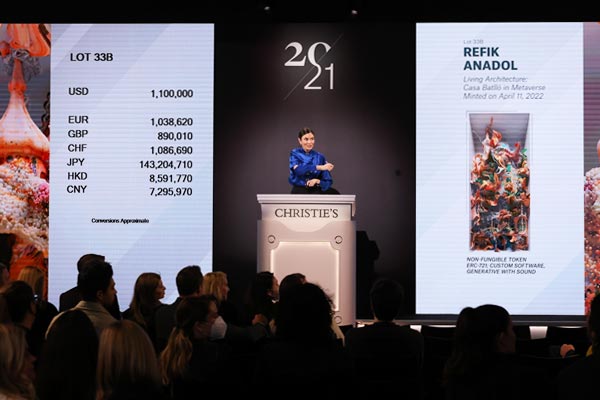
“Living Architecture: Casa Batlló” artpiece, is a representation of the iconic Casa Batlló’s façade created by turkish-american director and media artist Refik Anadol, under the institution’s initiative, has raised 1,38 million USD (1,3 million euros) and 10% Will be destined to Associació Aprenem Autisme, and to Fundación Adana, who specialize on neurodivergence support. The piece was part of the auction: 21st Century Evening Sale that took place at Christie’s in New York this past may 10th. Watch the auction’s video here (from 01:40:50).

“Living Architecture: Casa Batlló” has been the only NFT in the in the renowned “Christie’s Spring Marquee Week” auction (9-14 de mayo). The lots include pieces by Warhol (with his “Shot Sage Blue Marilyn”) which broke records in art history with 195 million USD raised, and pieces by Van Gogh, Monet, Rothko, Picasso, Basquiat or Banksy as well. (You can browse the artpieces here)

The auctioned piece is a dynamic NFT, a pioneer artpiece that changes in real time depending on the evironmental data collected in the city and the ephemerides that are celebrated on Casa Batlló’s façade (Sant Jordi, Christmas, social events…). To complete the artpiece’s immersive experience, Firmenich’s digital innovation center, D-LAB, has used the house’s images digital data combined with Barcelona specific olfactive descriptors, to create a unique fragance guided by AI that represents the house’s smell.

Refik Anadol’s “Living Architecture: Casa Batlló” artwork being auctioned at Christie’s, New York, on May 10th.

According to Gary Gautier, Casa Batlló’s CEO: “Casa Batlló’s commitment with digital art continues in the new platform casabatllo.io, where we will shortly show digital sales from invited artists’s collections, having Refik Anadol among them, always linked to donations for neurodiversity-related institutions.”

The pioneer AI artist and digital architect Refik Anadol states: “We live in an advanced technology era, but we don’t know how to remember our past and our heritege in an accurate way yet. And i think this project is a great example of the use of history and heritage, combined with technology and the future. Therefore, one of the reasons why this project is so meaningful is beacuse of its respectful use of historical data, but also because of its combination with future technologies like AI Data, the metaverse, NFTs and blockchain. The result is an excited imagination, where tha past and the future can truly connect.”

Casa Batlló is the first UNESCO World Heritage building that has been reinterpreted in a NFT form, with a pioneer artpiece that changes in real time through AI.

The piece will stay exhibited in Casa Batlló and is included in the cultural visit. It may be added that a great general public enjoyed a mapping version of the piece, which was projected on Casa Batlló’s façade on may 7th before 47.000 attendees

Image of the mapping Refik Anadol projected on the façade of Casa Batlló, on May 7.

A Historic Auction for the Neurodiversity

Casa Batlló is committed to seeking integration and diversity of workers. Since the beginning of 2021, it has had an entire neurodivergent visitor care team of 50+ people (with autism, dyslexia, dyspraxia, ADHD, etc.), thanks to the strategic alliance with social organization Specialisterne. Therefore, a percentage of the donation from the auction of the work will go to two local institutions specialized in comprehensive care and family support for people with neurodivergence: the Aprenem Autisme Association, with an annual attendance of more than 6,000 people working towards the inclusion of people with autism through a family care program, and the Adana Foundation, which offers ongoing treatment to more than 900 children and youth, from early diagnosis to therapeutic plan.